Mapping China’s AI landscape 2023-2025
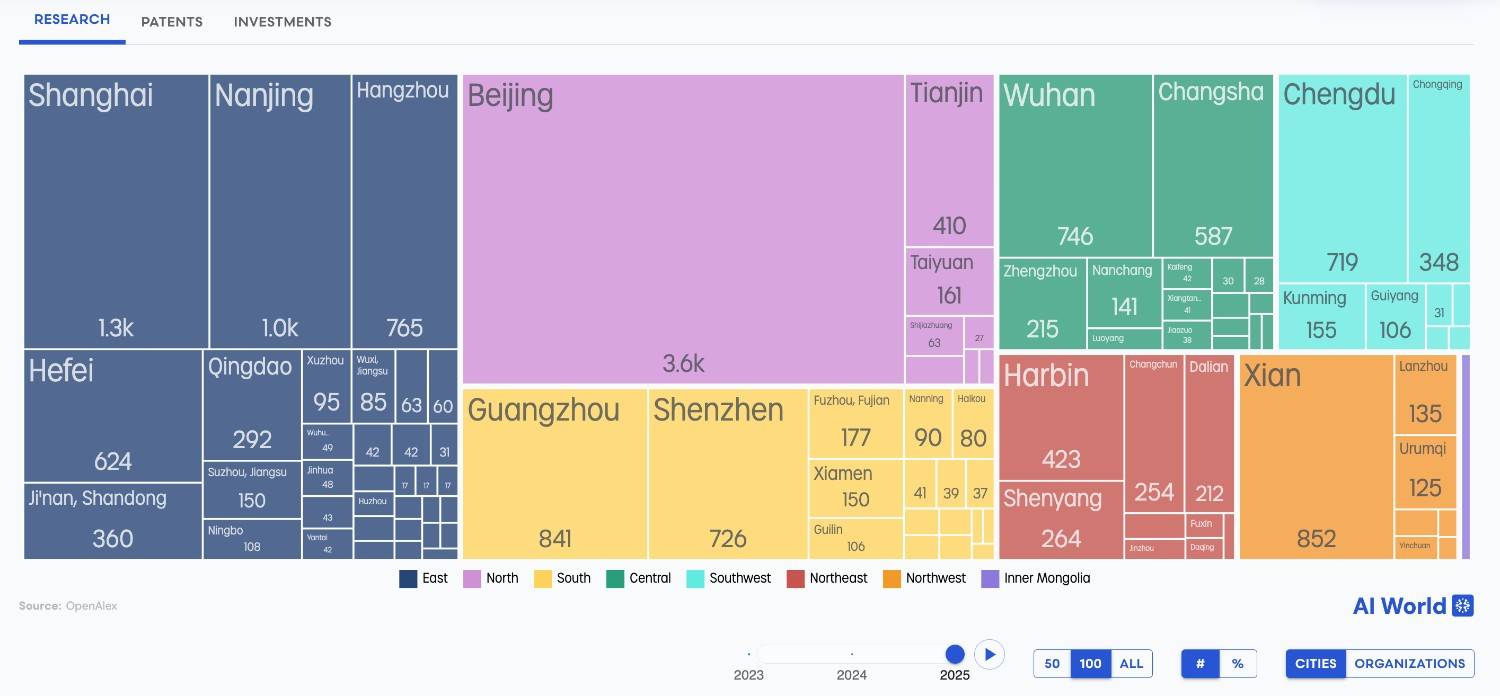
From 2023 to 2025, China's AI ecosystem revealed a divergence between where research was conducted and where capital was concentrated. While research activity emerged from a geographically diverse base, investment followed a more selective trajectory.
AI research hubs were widely distributed across the country, reflecting a broad innovation footprint that extended well beyond the traditional coastal hubs. In 2025, the top five cities by AI research output were:
- Beijing
- Shanghai
- Nanjing
- Xi’an
- Guangzhou
Beyond Beijing's leading position, Nanjing's and Xi’an's presence alongside tier-one cities highlights the role of strong regional universities and state-backed research institutes in shaping China’s AI research landscape. Research excellence is not confined to coastal megacities, but extends deep into central and western regions, producing a nationally distributed pipeline of AI talent and scientific output.
Investment patterns, however, followed a different logic. In 2025, AI funding was primarily concentrated in eastern, northern and southern China. The top three cities by AI investment in 2025 were:
- Beijing ($4.4 billion) - leading by a wide margin
- Shanghai ($1.1 billion)
- Shenzhen ($1 billion)
In Beijing, there is a strong alignment between research output and investment, creating an innovation and business cycle similar to that observed in Paris or San Francisco. Yet the gap widens considerably for other cities (e.g. Nanjing, Xi'an).
This suggests that, although the country has successfully distributed AI research capacity across numerous cities, capital allocation remains concentrated in established metropolitan centres.