The EU AI ecosystem 2023–2025: mapping the gap between research and capital
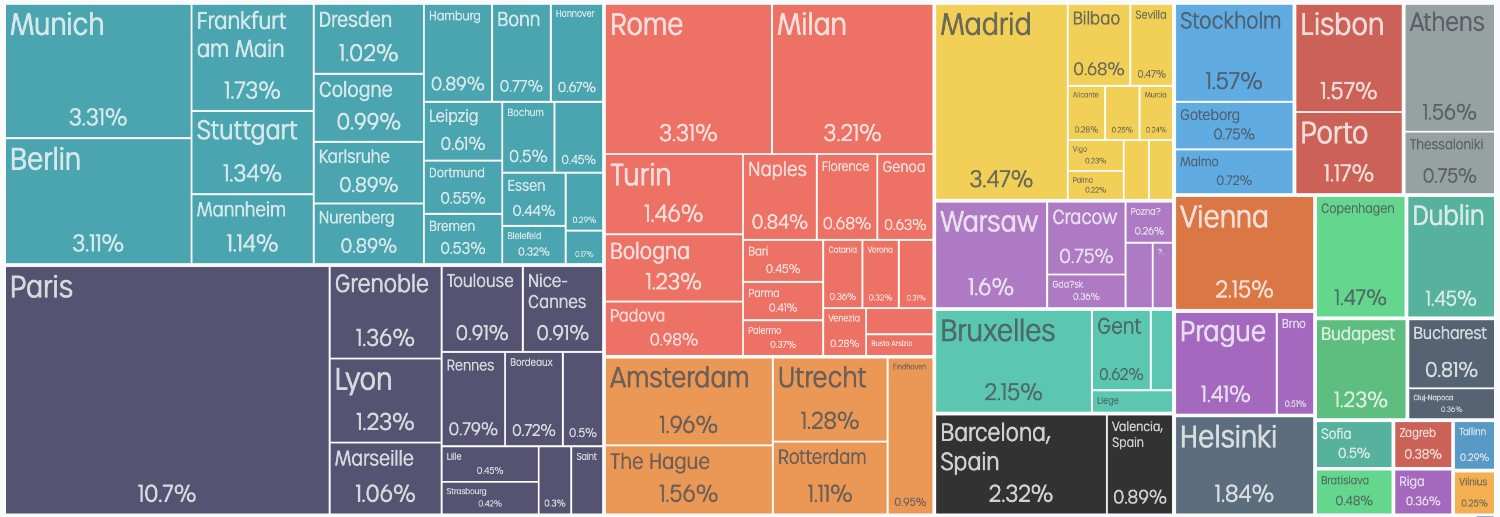
From 2023 to 2025, the European Union’s AI ecosystem expanded considerably. Yet, taking a closer look, this growth masks a structural divide between leading hubs and those falling behind.
While AI knowledge production across Europe remains democratised and resilient, the 2025 research landscape reveals a vibrant yet increasingly polarised environment that resists simple categorisation.
The top five cities by research output in 2025 were:
- Paris (891)
- Madrid (290)
- Rome (277)
- Munich (277)
- Milan (268)
Innovation is not confined to the usual economic heavyweights. Southern Europe, with its strong research base in cities such as Madrid, Rome and Milan, proves that academic excellence is evenly distributed across Southern, Western and Central Europe.
However, funding patterns deviate from where leading research is being conducted.
In 2025, AI investment did not broadly chase research; instead, it clustered into a few flagship hubs.
The top five European cities by AI investment in 2025 were:
- Paris ($3 billion) - which led by a wide margin
- Munich ($1 billion)
- Stockholm ($850 million)
- Berlin ($842 million)
- Barcelona ($298 million)
A clear geographical difference exists between research and funding, clearly showing a dominance of northern AI hubs leading in terms of investment.
Aside from Barcelona, significant funding is being invested in France, Germany and the Nordic countries. Paris stands alone as the dual engine of the EU, dominating both lists, while other research-rich cities struggle to attract matching funding.
What does this data reveal about the EU´s AI ecosystem?
Although Europe has a broad and robust research base, investment does not always reflect research intensity.
In established hubs such as Paris and Munich, strong research output is closely mirrored by capital concentration, creating a self-reinforcing loop of innovation and commercialisation.
In emerging hubs, however, this alignment appears to be weaker, revealing a structural imbalance in the EU AI ecosystem where knowledge creation outpaces capital allocation.
This represents both a risk and an opportunity: a risk of brain drain as researchers move to better-funded hubs, but also the opportunity for research-rich regions to attract investment.